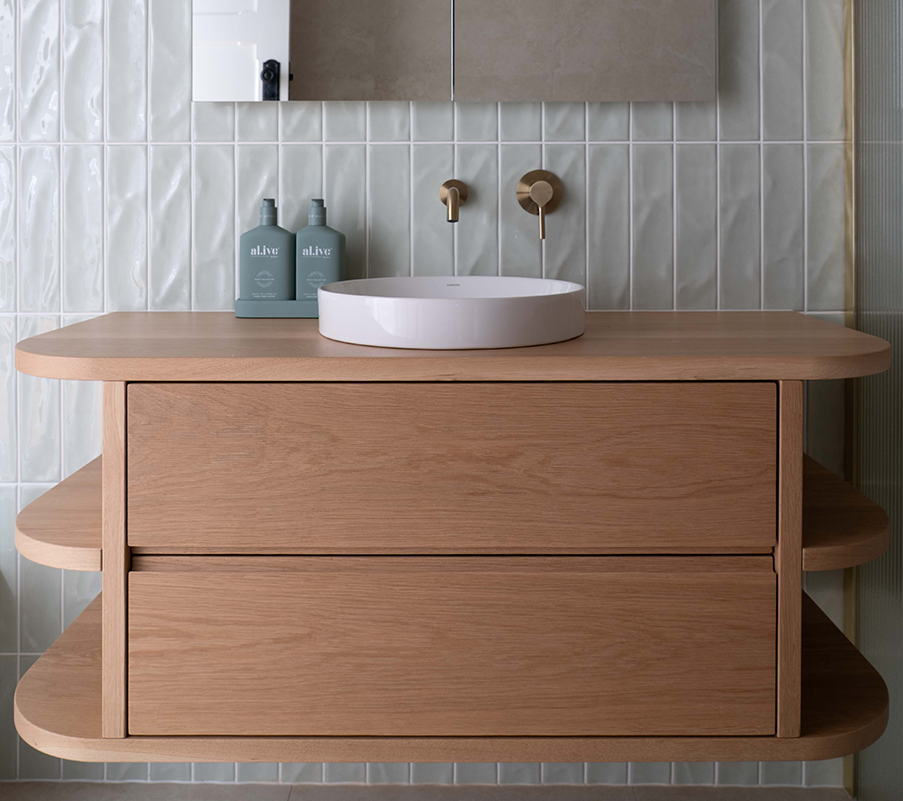
Tasmanian Oak is an Australian hardwood with a pale honey colour and a clean, even grain. It’s durable, works well in wet areas when properly sealed and suits a wide range of interior styles from contemporary to traditional. It’s the species we recommend most often for smaller bathrooms, light-filled kitchens, and spaces where the focus is on warmth and liveability rather than a striking centrepiece.
What makes it particularly well suited to custom furniture is that no two boards are identical. The pale honey tones shift subtly from board to board, and the gum veins that run through the grain ensure every finished piece is genuinely one of a kind.
Origin And Characteristics
Despite the name, Tasmanian Oak isn’t actually an oak. It’s a commercial term used for three Australian eucalypt species harvested from Victoria and Tasmania: Eucalyptus regnans (Mountain Ash), Eucalyptus obliqua (Messmate), and Eucalyptus delegatensis (Alpine Ash). These species are visually similar and are sold interchangeably under the Tasmanian Oak name.
Janka hardness sits at around 1100, which puts it in the medium hardwood range. It’s softer than American Oak but harder than pine or cedar and durable enough for furniture and cabinetry across most applications.The colour ranges from pale straw blonde to light pinkish-tan, with occasional warmer honey tones depending on the individual board.
The grain is typically straight with some interlocking grain and visible gum veins that give each piece genuine character. There’s more colour variation between boards than you’d see with American Oak, which is worth knowing if you’re building a large vanity or benchtop where surface consistency matters. Also, Tasmanian Oak is domestically sourced, which has practical advantages in terms of availability and supply lead times compared to imported species.
When we select Tasmanian Oak at the workshop, we lay boards side by side to assess how the colour and grain sit together across the finished piece. That selection process is part of what separates custom furniture from off-the-shelf alternatives.
Performance Across Different Applications
Vanities and Bathroom Cabinetry
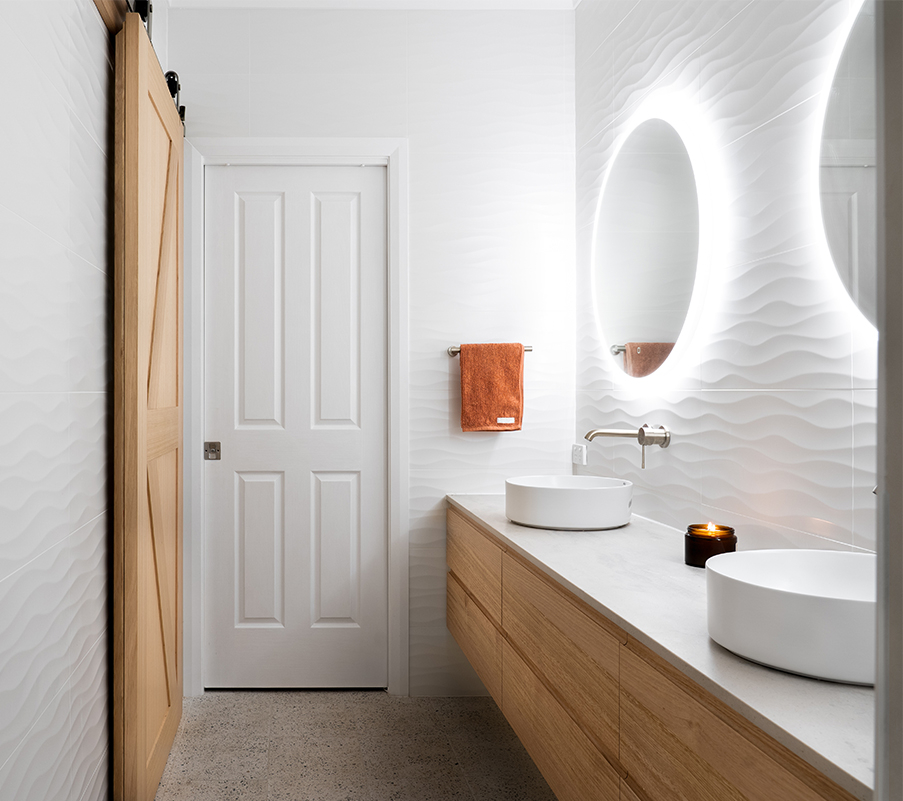
Tasmanian Oak performs well in bathrooms when sealed properly. It’s less dense than American Oak or Blackwood, so we pay particular attention to sealing the end grain and any natural fissures before applying our water-based polyurethane finish. Once sealed correctly, it’s durable and moisture-resistant, handling daily humidity, basin splashes, and cleaning products without issue.
The light colour makes it particularly well-suited to smaller bathrooms and powder rooms where a darker timber like Walnut or Blackwood can feel visually heavy. Tasmanian Oak keeps a space feeling open and considered. It pairs naturally with white stone basins, brushed nickel or chrome fixtures, and neutral tile palettes.
In bathrooms with limited natural light, the warm honey tone reflects light into the room in a way that darker species simply cannot. If you’re still weighing up which vanity material suits your bathroom, ourbathroom vanity materials comparison covers timber alongside MDF and laminate options.
Kitchen Benchtops
Tasmanian Oak works well as a benchtop in residential kitchens. It’s not as hard as American Oak or Spotted Gum, so it will show dents and surface wear more readily under heavy use, but for most households, it performs well and costs significantly less than imported hardwoods.
The warm undertone softens contemporary kitchens that might otherwise feel cold and brings a material quality to the space that laminate alternatives cannot replicate.
We apply a satin or matte polyurethane that can be lightly sanded and resealed when the surface shows wear over years of use. That option isn’t available with laminate or stone, which is one of the practical long-term advantages of investing in solid timber. If you’re deciding whether timber works for your kitchen, our post on choosing timber benchtops covers the key considerations.
Furniture and Shelves
For dining tables, floating shelves, entertainment units, sideboards, and bedroom furniture, Tasmanian Oak is a reliable and widely used choice. It’s stable across spans, machines cleanly, and the grain adds genuine visual interest. The light, warm colour works alongside most wall and floor tones without competing.
Stained finishes are also common with Tasmanian Oak. If you’re matching new cabinetry or shelving to existing timber joinery, doors, or flooring in the home, a custom-mixed stain on Tasmanian Oak can get you close to the target colour. This is harder to achieve with American Oak or Blackwood, which have a stronger inherent colour that tends to show through most stains.
How Tasmanian Oak Ages
Tasmanian Oak deepens with age and UV exposure, developing a warmer, slightly amber tone over time. The change is more pronounced than American Oak but less dramatic than some other eucalypts. Most clients find the aged colour an improvement on the fresh-cut timber. It gains warmth without losing the light, airy quality that makes it suited to contemporary interiors.
The pronounced grain means minor scratches and surface wear blend into the texture rather than standing out. Well-maintained pieces develop a warm patina over time that is difficult to replicate with newer materials. If the finish shows wear after years of heavy use, Tasmanian Oak can be sanded back and resealed without difficulty.
How To Maintain Tasmanian Oak Furniture
Maintenance is straightforward once the timber is properly sealed. For bathroom vanities and kitchen benchtops, wipe surfaces with a damp cloth after use and clean spills promptly. Use pH-neutral cleaners and avoid bleach-based products or abrasive scrubs, as they can wear through the polyurethane finish over time.
For furniture in dry areas, dust regularly and wipe with a slightly damp cloth as needed. The sealed surface resists most household spills when cleaned promptly. After years of heavy use, finish wear around drawer fronts or high-contact areas is normal.
The surface can be lightly sanded and resealed, restoring the piece without replacement. This is one of the advantages solid timber has over veneered or laminate alternatives, which cannot be refinished once the surface layer is compromised.
Finish Options For Tasmanian Oak Furniture
Clear matte polyurethane is the standard finish for Tasmanian Oak when the goal is to keep the natural light colour. It protects the timber, doesn’t add gloss, and keeps the warmth of the grain visible. Run your hand across a matte-finished Tasmanian Oak surface and the texture is smooth without feeling synthetic. The timber still feels like timber. Matte suits most contemporary and Scandinavian-leaning interiors.
Satin polyurethane adds a subtle sheen that lifts the warmth of the golden tones slightly. It suits dining tables and furniture pieces where a slightly more finished quality is appropriate without moving into high gloss.
Stained finishes work well when matching existing timber in the home. Tasmanian Oak accepts stains more evenly than most species, which gives greater flexibility in colour matching.
Oil finishes work well on Tasmanian Oak furniture in dry areas, bringing out the grain and adding warmth. As with other species, we don’t recommend oil for bathroom vanities or kitchen benchtops due to moisture exposure and ongoing maintenance requirements.
Difference Between Tasmanian Oak And American Oak
These are the two light timber species we work with most, and clients regularly ask how they compare before making a decision.
Species: They are unrelated. American Oak is a true oak (Quercus alba), while Tasmanian Oak is a eucalypt. The name similarity is purely a commercial convention.
Colour: Both sit in the pale to golden range. Tasmanian Oak has more warmth and pinkish-tan tones, with more variation between boards. American Oak is a cooler, more neutral blonde and is more consistent across large surfaces.
Grain: American Oak has a more pronounced grain pattern, including characteristic ray fleck that appears as fine, reflective lines across the face of the board. Tasmanian Oak has a cleaner, more variable grain with visible gum veins that give it its own kind of character.
Hardness: American Oak is harder, sitting at around 1360 Janka compared to Tasmanian Oak’s 1100. The practical difference is noticeable in high-use applications like kitchen benchtops.
Staining: Tasmanian Oak takes stains more reliably and evenly. If colour matching to existing joinery is a priority, Tasmanian Oak gives you more flexibility.
Origin: Tasmanian Oak is Australian-sourced. American Oak is imported, which contributes to its higher cost.
Cost: Tasmanian Oak is more accessible in price due to domestic supply. For larger projects where material costs carry real weight, the difference is worth factoring in.
Wall-Hung vs Floor-Mounted Bathroom Timber Vanities
Both installation styles work well with Tasmanian Oak, and the sealing process is identical for each. The choice comes down to how you want the timber to sit in the space.
Wall-hung Tasmanian Oak vanities lift the timber off the floor, keeping the room feeling open and making floor cleaning easier. Because Tasmanian Oak is already a light, pale timber, the floating effect adds to that airiness rather than creating the contrast you’d see with a darker species. It suits contemporary bathrooms with large format tiles and minimal hardware.
Floor-mounted Tasmanian Oak vanities feel more grounded and suit bathrooms where the vanity is more of a furniture piece than a fitted cabinet. They work well in spaces with decorative or patterned floor tiles where full coverage of the floor area is preferable. The light timber colour means a floor-mounted unit doesn’t close a room down the way a darker timber would.
For smaller bathrooms where the brief is to keep the space feeling as open as possible, wall-hung is usually the better call. For larger bathrooms or en-suites where weight and presence are part of the design, either style works equally well. Both are built to the same standard in our Adelaide Hills workshop, with the same sealing process and hand-applied finish regardless of installation style.
When Tasmanian Oak Is The Right Choice
Choose Tasmanian Oak if:
- You want a light, warm timber that suits a wide range of interior styles
- Your bathroom benefits from a lighter-coloured species that reflects rather than absorbs light
- You need to match existing timber joinery or flooring through staining
- You prefer domestically sourced Australian hardwood
- Budget is a consideration relative to American Oak or American Walnut
Consider alternatives if:
- You want maximum hardness and durability (American Oak)
- You need a very consistent colour across large surfaces (American Oak)
- You want a darker, more prominent timber (American Walnut or Tasmanian Blackwood)
- You want one-of-a-kind grain and character markings (Wormy Chestnut)
Not Sure Which Timber Species Suits Your Space?
At STADC Surfaces, we specialise in custom solid timber furniture for Adelaide homes. We work through timber selection based on your project requirements, not just aesthetics. Hardness, grain, colour, and finish all affect how a piece performs in daily use, and we’ll walk you through what matters for your specific application.
Visit our Adelaide Hills workshop to see samples of the full range of timber species we work with, or get in touch to discuss your requirements.
See how we use Tasmanian oak in our timber bathroom vanities and timber benchtops, or request a quote.