Choosing bathroom vanity materials affects how well your vanity performs, how long it lasts, and how it looks over time. Timber, MDF, and laminate are the three main materials used in bathroom vanities. Each has different characteristics that suit different budgets, expectations, and bathroom conditions.
Understanding these differences helps you choose a vanity that actually works for your Adelaide bathroom rather than just looking good in the showroom.
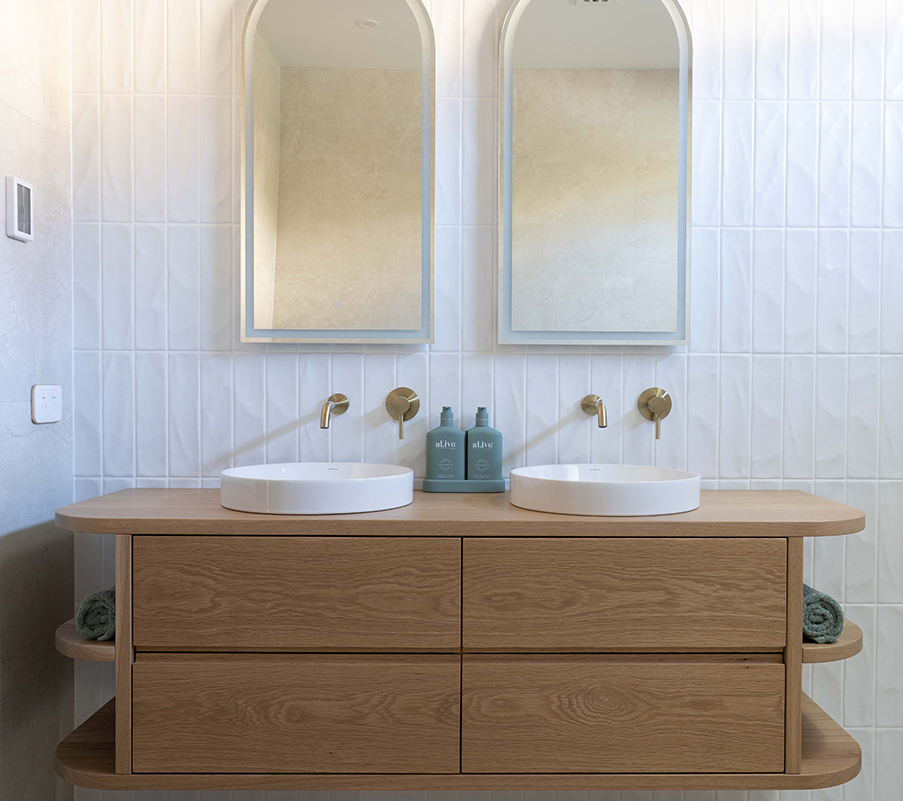
Solid Timber Vanities
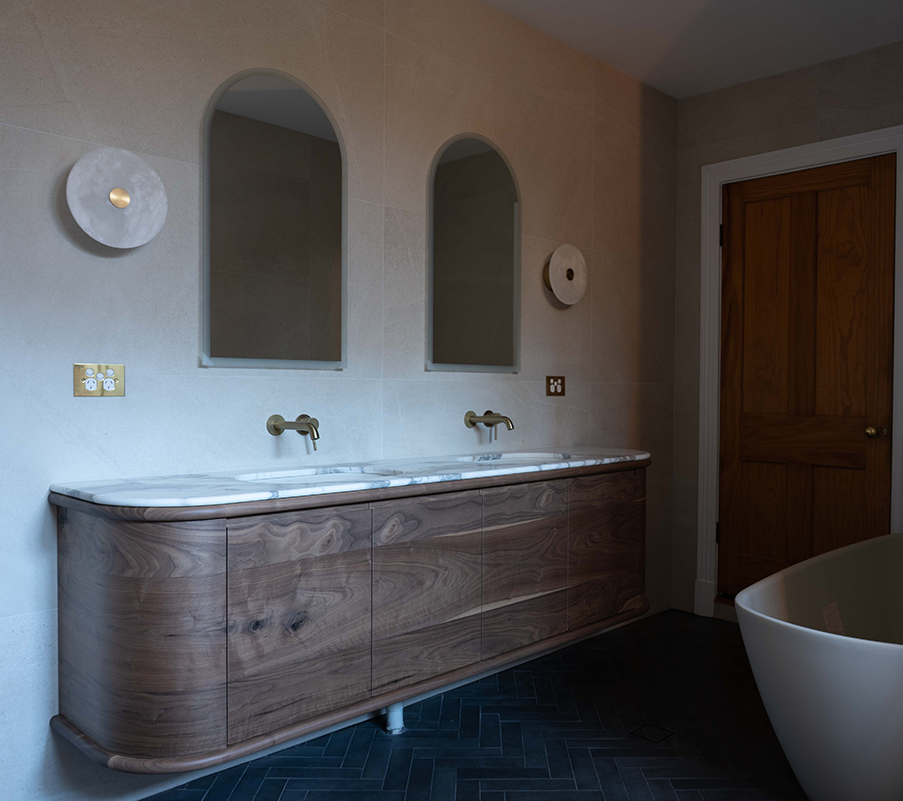
Solid timber vanities are constructed from hardwood species like American Oak, Tasmanian Oak, Blackwood, or Walnut. The entire structure uses real timber, not timber-look finishes over cheaper cores.
Properly finished solid timber handles bathroom conditions well. The timber is kiln-dried before construction, then sealed completely on all surfaces with water-based finishes. This creates moisture barriers that protect the wood while allowing slight natural changes in wood.
Moisture Resistance
The timber species and finishing determine moisture performance. Dense hardwoods with complete sealing (all surfaces, including backs and bottoms) handle bathroom humidity without issues.
Problems occur when timber isn’t properly dried before construction, when finishing is incomplete or when bathrooms have inadequate ventilation. The material isn’t the issue, but the preparation and finishing quality determines the performance.
Appearance Over Time
Timber develops patina. Light colour changes, subtle grain enhancement, and minor marks that add character. Many people love this authentic, evolving quality. It makes the vanity feel lived-in rather than showroom-new.
If you want your bathroom to look identical years later, timber won’t deliver that. If you appreciate natural materials that age gracefully, timber does this beautifully.
Repairability
Highly repairable. Scratches sand out. Water marks can be addressed. Damaged sections can be replaced. The entire vanity can be refinished decades later, looking new again. This repairability extends the lifespan significantly. Quality timber vanities can function beautifully for 30+ years with appropriate care.
Cost
Solid timber vanities cost more than MDF or laminate options. The material itself costs more. Skilled construction takes time. Quality finishing adds expense. But the lifespan, beauty and repairability often make timber a better long-term value despite a higher initial cost.
MDF Vanities
MDF (Medium Density Fibreboard) Vanities are manufactured from wood fibres bonded with resin under pressure. It’s denser and more uniform than particleboard. Most affordable vanities use MDF as the core material, covered with laminate, vinyl wrap or timber veneer.
Medium Density Fibreboard vanities perform good in bathrooms when properly sealed and in well-ventilated spaces. Modern moisture-resistant MDF has improved over older versions. However, MDF’s fundamental characteristic is that it’s highly absorbent if moisture reaches the core. Once water penetrates the surface finish and reaches MDF, it swells. This swelling is permanent.
The material doesn’t return to its original dimensions when it dries. Edge sealing quality matters enormously with MDF vanities. Poorly sealed edges (around basin cutouts particularly) are where moisture enters most commonly.
Moisture Resistance
Moisture-resistant MDF (sometimes called green board or blue board due to colour) performs better in humid environments than standard MDF. But it’s still more vulnerable to water damage than solid timber. The surface finish provides the real protection. Laminate, vinyl wrap, or veneer must be completely sealed at edges and joints. Any gaps allow moisture penetration.
Appearance Over Time
MDF vanities maintain a consistent appearance when undamaged. The surface doesn’t age like timber. It stays looking new, or it starts showing damage. There’s less middle ground.Common aging issues include edge swelling near water exposure, surface laminate lifting, and general wear that shows as the protective surface wears through.
Repairability
Limited. Surface damage (scratched laminate, lifted edges) is difficult to repair invisibly. MDF bathroom vanities that have swollen from moisture cannot be repaired. Replacement is usually the only solution. Veneer over MDF can sometimes be refinished, but options are limited compared to solid timber.
Cost
MDF vanities cost less than solid timber. Material costs are lower. Manufacturing is faster. This makes MDF suitable for tight budgets or situations where longevity isn’t the priority. For rental properties, budget renovations, or temporary solutions, MDF offers reasonable value. For long-term family homes, the lack of repairability and shorter lifespan can make it a less ideal choice.
Laminate Vanities
Laminate refers to the surface material, not necessarily the core. Most laminate vanities have MDF or particleboard cores with a laminate surface bonded on. The laminate is a printed pattern (often timber-look) protected by clear resin. Performance depends heavily on substrate quality and edge sealing.
High-pressure laminate over moisture-resistant MDF performs reasonably well. Cheap laminate over standard particleboard performs poorly in humid bathrooms. Quality laminate surfaces resist water well. Problems occur at edges, joins, and anywhere the laminate edge isn’t perfectly sealed to the substrate.
Moisture Resistance
The laminate surface itself is quite water-resistant. But like MDF vanities, moisture reaching the substrate causes swelling and damage. Check edge sealing quality carefully. Poorly finished edges around basin cutouts are common failure points.
Appearance Over Time
Laminate maintains its appearance well when undamaged. It won’t age or develop a patina. It stays looking the same or starts deteriorating. Scratches show clearly on the laminate because the printed pattern is thin. Deep scratches reveal the substrate beneath. The timber-look is obviously printed rather than genuine.
For people who love the look of timber but can’t afford solid timber, laminate provides that aesthetic at a lower cost. But it never quite achieves the depth and authenticity of real timber.
Repairability
Very limited. Scratched laminate cannot be sanded and refinished like timber. Damaged areas are permanent. Replacement is typically the only solution for significant damage.
Cost
Similar to MDF vanities. Often slightly less expensive. The budget-friendly option for bathroom renovations, where cost is the primary driver.
How These Materials Compare in Real Use
Each material has its place. Solid timber offers longevity and repairability. MDF provides a budget-friendly option. Laminate delivers timber aesthetics at lower cost.
But understanding how they compare directly helps clarify which suits your bathroom best. The key differences come down to lifespan, maintenance requirements, environmental impact, and how each material responds to bathroom conditions over time.
Solid Timber Vanities | MDF Vanities | Laminate Vanities | Comparision | |
Lifespan In bathroom Conditions | Expected lifespan is 20-30+ years with proper care. Can be refinished and continue performing well indefinitely. Quality improves with age when properly maintained. | Expected lifespan is 7-15 years depending on quality and bathroom conditions. Replacement becomes necessary when moisture damage or surface wear becomes significant. | Expected lifespan is 7-12 years in bathroom conditions. Similar to MDF in longevity. Surface durability is slightly better than basic MDF with vinyl wrap. | The lifespan difference matters when calculating the actual value. A timber bathroom vanity costing double the MDF bathroom vanity but lasting triple the time offers better value over 20 years. |
Ventilation Requirements for Each Material | Handles normal bathroom humidity well with good ventilation. Struggles in perpetually damp, poorly ventilated bathrooms. Requires windows that open or properly sized exhaust fans. | More sensitive to moisture than timber. Poor ventilation accelerates deterioration. Edge swelling and surface lifting occur faster in high-humidity environments. | More sensitive to moisture than timber. Poor ventilation accelerates deterioration. Edge swelling and surface lifting occur faster in high-humidity environments. | All bathroom vanity materials benefit from good ventilation. If your bathroom has ventilation issues that can’t be improved, consider whether any timber-based vanity (including MDF and laminate) is appropriate. |
Maintenance Requirements Compared | Need regular attention. Wipe water splashes promptly. Clean with a damp cloth and dry. Check the finish condition annually. Refinish high-wear areas every few years as needed. | Lower maintenance day-to-day. Clean with a damp cloth. Avoid excessive water. No refinishing possible, so maintenance is about preventing damage rather than renewing surfaces. | Similar to MDF. Clean regularly. Avoid abrasive cleaners that scratch the surface. Once damaged, no repair options exist. | Timber requires active care but rewards it with longevity. MDF and laminate require less care but cannot be renewed when they eventually wear out. |
Environmental Considerations | Can be sustainably sourced. Look for certified timber (FSC, Responsible Wood). At the end of life, timber can be repurposed or composted. | Made from wood fibres and resin. Manufacturing requires energy. Resins involve chemicals. At the end of life, MDF goes to a landfill. Less environmentally friendly. | Combines multiple materials (substrate, printed layer, resin). Difficult to recycle. Ends up in a landfill. The environmental footprint is higher. | The environmental footprint of MDF and laminates is higher than that of solid timber. |
Choose solid timber vanities if you value quality and longevity. You appreciate natural materials that age gracefully. The budget allows for the investment. You’re willing to provide regular care.
Want to learn more? Read our latest blog on how to choose the right size Timber Vanity for your bathroom
Custom Timber Vanities For Adelaide Bathrooms
At STADC Surfaces, we specialise in custom timber vanities crafted from solid hardwood species. Each vanity is built in our Adelaide Hills workshop with complete sealing on all surfaces for proper moisture protection. We work with all timber species that perform well in bathroom conditions including American Oak, Tasmanian Oak, Blackwood, and Walnut
We’d be happy to discuss whether timber suits your bathroom and can walk through different options, finishing approaches, and realistic expectations for how they’ll perform in your home. Contact us or visit our Adelaide Hills factory to experience our craftsmanship firsthand.